Netflix: The Incredible Business Story Behind Streaming.
Netflix didn’t start as a streaming company.
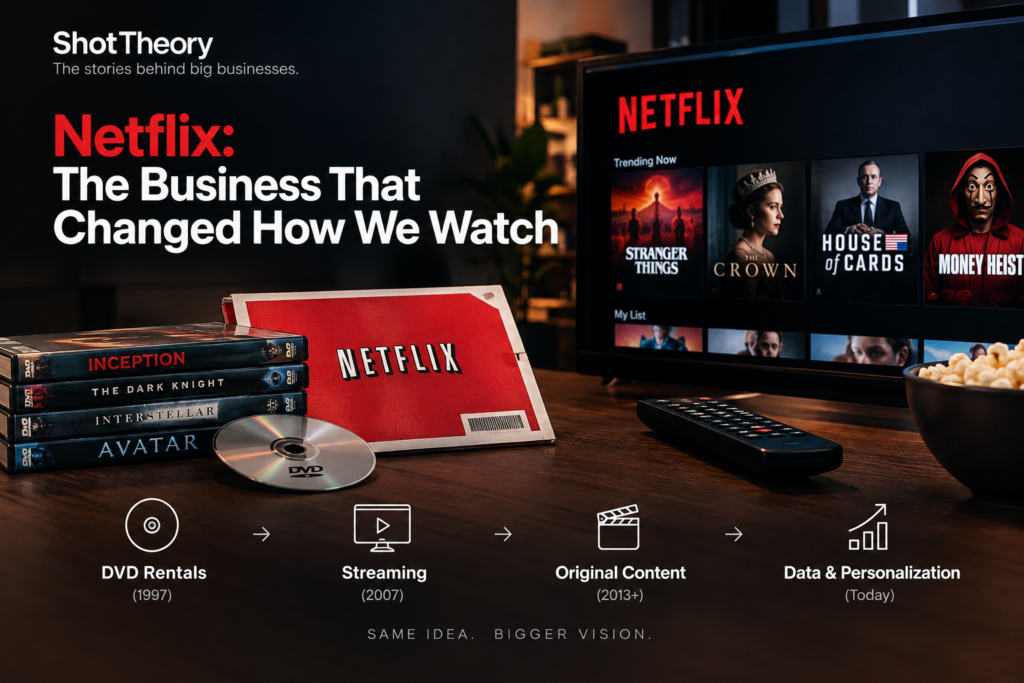
In 1997, it was a DVD rental business. Customers could order movies online and receive DVDs at home. There were no streaming apps, no “Netflix and chill,” and definitely no endless scrolling through recommendations.
But Netflix saw something important: people wanted entertainment to be easier.
That simple idea became the foundation of a massive business.
1.From DVDs to Streaming
In the early days, Netflix competed with traditional video rental stores. Its biggest advantage was convenience. Customers didn’t have to drive to a store, search through shelves, or worry about late fees.
Netflix eventually introduced a subscription model, allowing customers to rent DVDs for a monthly fee.
But the company knew DVDs wouldn’t last forever.
As internet speeds improved, Netflix made a much bigger move: streaming.
Instead of waiting for a DVD to arrive, customers could watch movies and shows instantly.
This completely changed the business.
Netflix was no longer just a company that rented movies. It was becoming a technology and entertainment company.
2.Netflix Started Making Its Own Content
Streaming created another problem.
If Netflix depended only on movies and shows owned by other companies, those companies could eventually take their content away.
So Netflix changed its strategy again.
It started investing heavily in original content.
Shows like House of Cards, Stranger Things, and The Crown helped Netflix build something much more valuable than a rental service: its own entertainment library.
This gave people another reason to stay subscribed.
Netflix wasn’t just selling access to entertainment anymore.
It was creating entertainment for subscriber.
3.The Power of Data
There is another part of Netflix’s business that often gets overlooked: data.
Netflix studies what people watch, when they stop watching, what they search for, and what types of content they enjoy.
That information helps Netflix make recommendations and understand what its audience wants.
Think about it.
When Netflix shows you a movie you might like, that isn’t completely random. The platform has learned from millions of viewing decisions.
This creates a powerful business loop:
More viewers → more data → better recommendations → more engagement.
And more engagement can help Netflix keep customers subscribed.
4.Netflix Changed the Competition
Netflix didn’t just compete with other streaming companies.
It changed what consumers expected from entertainment.
People became used to watching what they wanted, whenever they wanted. Waiting for a particular day and time to watch a TV episode started to feel outdated.
Other companies eventually followed the streaming model, creating a much bigger streaming industry.
Netflix helped prove that consumers were willing to move from traditional television and physical media to online entertainment.
5.The Real Business Lesson
Netflix’s biggest success wasn’t simply creating a streaming service.
It was changing its business before the old model became a problem.
DVDs worked. But Netflix didn’t become comfortable with DVDs.
Streaming worked. But Netflix didn’t stop there.
It moved into original content, technology, global markets, and new ways of keeping viewers engaged.
That’s what makes Netflix an interesting business case.
The company kept asking one question: What will customers want next?
And then it built around the answer.
The Netflix also understood the importance of timing. It entered streaming when internet usage was growing and later invested in original content as competition increased. These decisions were risky, but they helped Netflix stay ahead. The company kept adapting instead of depending on one successful idea for too long.
The Shot Theory
The Netflix didn’t win by protecting its original business.
It won by being willing to change it.
Find the shift. Move early. Build for what comes next.